Rose Creek Press

Family history,
documented
& remembered.

Where remembrance becomes record.

Scroll

Across the Centuries

One lineage, three thousand years

This family’s paternal line reaches back across millennia — into the same deep ancestry as a pharaoh of Egypt, the same homeland as the wealthiest ruler in recorded history, and the same people as one of West Africa’s great women leaders.

c. 1186 BCE
Ancient Egypt
Ramesses III
Pharaoh

Shares the deep paternal branch — haplogroup E1b1a — confirmed in the pharaoh’s own DNA.

c. 1312 CE
Mali Empire
Mansa Musa
Emperor of Mali

Of the same Mandé homeland and Mali Empire world from which this paternal line springs.

c. 1849 CE
Sierra Leone
Madam Yoko
Paramount Chief

Led the Mende — one of the very peoples whose DNA anchors this lineage today.

A connection of shared ancestry and homeland — traced through Y-DNA evidence, not claimed descent.

Our Flagship Volume

The Bearden Family

Seven Generations of Migration, Resilience, and Achievement

In 1937, a man named C.B. Burton sat for an interview in Newberry, South Carolina, and described what he had lived through under slavery. His was one of only about 2,300 such voices ever recorded — roughly one in a thousand of the people enslaved in America. He spoke of the same plantation world from which this family’s own ancestors emerged.

1 in 1,000 voices from slavery, preserved across nearly a century

The Bearden Family is the result of one man’s decade of research: seven generations traced from the Senegambian coast of West Africa, through the red clay of Georgia and the cotton fields of South Carolina, to the steel towns of Pennsylvania — a family of free people of color, soldiers, and migrants who carried their story forward in the belief that remembrance is itself a form of honor.

Coming 2026

The book is in final production. Sign up to be the first to know when it’s available — in print, and as a keepsake edition.

Or tell me how we’re connected →

The Journey

Two lineages, one family

The paternal Bearden line through Georgia and the maternal Burton and Shells lines through South Carolina — two distinct journeys out of West Africa that converged, generations later, in Pennsylvania.

Map tracing the Bearden family migration: the paternal line from Senegambia to Clarke County, Georgia, and the maternal Burton and Shells lines from Senegambia to Newberry and Edgefield, South Carolina, both converging in eastern Pennsylvania.

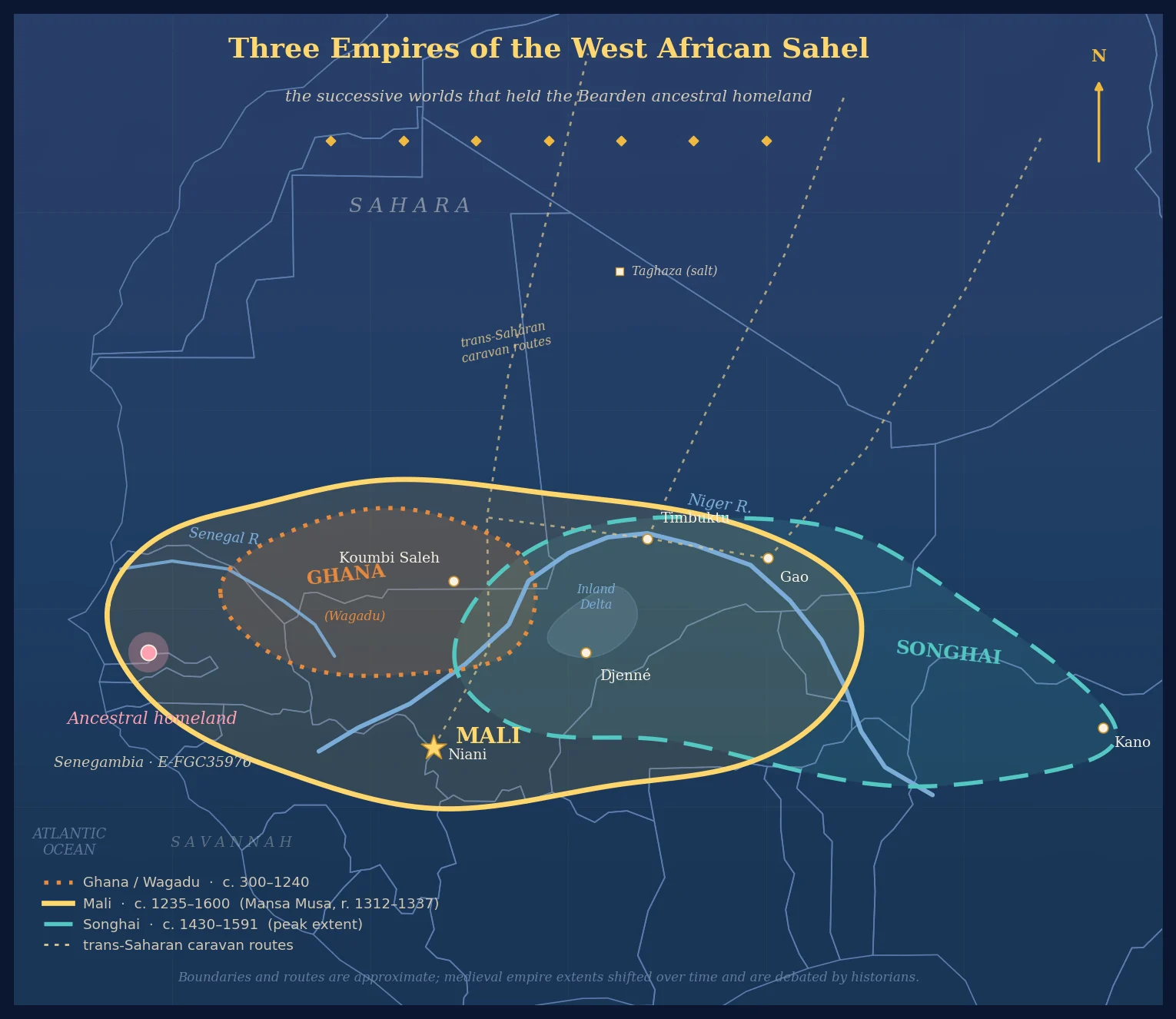
Before the crossing, there was a homeland. The family’s documented Senegambian origin lay at the heart of three of the great medieval empires of West Africa — Ghana, Mali, and Songhai — the world from which this lineage reaches forward across the centuries.

Map of three medieval West African empires — Ghana or Wagadu, Mali, and Songhai — shown over the Bearden family's ancestral Senegambian homeland, with the Niger River, the cities of Timbuktu, Gao, Djenné, and Niani, and the trans-Saharan caravan routes.

The First Diaspora

More than one road out of the homeland

Long before any ship sailed for America, the same Senegambian homeland behind this family’s paternal line was already scattering in other directions — north to Portugal, and out to the empty islands of the Atlantic. The crossing to America was the largest road out of this homeland. It was never the first, and never the only one.

c. 1462
Atlantic · 500 km offshore

Cape Verde

The offshore homeland

Uninhabited until the Portuguese settled it from the Senegambian coast — its African ancestry traces almost entirely to two peoples, the Mandinka and the Wolof, the very Mande and Senegambian homeland this line names. The least-diluted reservoir of that ancestry anywhere offshore, and the cradle of Kriolu.


1450s – 1490s
Madeira & São Tomé

The Sugar Islands

Where the plantation was forged

Madeira’s sugar estates became the model for plantation slavery — the prototype later carried to São Tomé, and only then west across the Atlantic to the Americas.

by the 1500s
Lisbon

Portugal

An African Europe

Lisbon held one of the largest African communities in Europe, Senegambians among the earliest — woven over the centuries into the Portuguese people themselves, a faint thread still legible in their DNA.

And on the rivers of Senegambia the lineages did not only part — they fused. Portuguese traders who settled the coast and married into African families left descendants who were both at once, a Luso-African world that brokered the trade for three centuries.

A shared homeland and a scattered family — traced through history and DNA, not through cousins any record could name.

The Maternal Line · The Rice Coast

What survived the crossing

The maternal line surfaces in the record in the South Carolina Midlands — but downstream of a longer passage. The people the Charleston planters prized came from the Rice Coast, the stretch of West Africa from Senegambia through Sierra Leone whose farmers carried, in their own minds, the rice knowledge that built the colony’s wealth. Some of what that coast carried across the water has never stopped speaking.

c. 1670s – 1808
Sierra Leone estuary

Bunce Island

The Rice Coast doorway

A British slaving castle in the estuary above present-day Freetown, sending its captives straight to Charleston for the rice country — the door through which the Rice Coast reached Carolina.

1839
Mendeland, Sierra Leone

Sengbe Pieh

The rice farmer who refused

Kidnapped from his fields, the Mende farmer seized the slave ship Amistad, won his freedom before the U.S. Supreme Court, and sailed home in 1842.

1933 · 1997
Harris Neck, Georgia

The Song That Crossed

The language they cried in

A Mende funeral song, carried unbroken for two centuries by a Gullah family of coastal Georgia and recorded in 1933 — traced home to one Sierra Leone village, where the singer’s daughter sang it at a graveside in 1997.

The Mende call the rite Tenjami — “crossing the river.” Two centuries after the water was first crossed, a family carried the song back across it.

The maternal line’s documented home is inland Carolina — Newberry and Edgefield. This is the Rice Coast world it rose from: shared homeland and shared culture, traced through history and DNA, not through names any record kept.

Why It Was Written

A son’s record

Beneath the documents and the DNA is a simpler thing — a son’s act of devotion. This book was written to carry a name and a face back to the people the record once tried to erase, so that they would not be lost again. It is, in the end, a love letter across generations.

“I wrote this for my father and my mother, for my brothers and my sisters, and for the generations still to come.”

About the Author

Kevin Eugene Bearden is a graduate of North Carolina A&T State University and a former United States Army Captain. He has spent his career supporting migration and resettlement services. The Bearden Family is the product of ten years of genealogical research into his own paternal and maternal lines. He is a member of the Afro-American Historical and Genealogical Society (AAHGS). He lives in Front Royal, Virginia.

Are We Connected?

Do you have family records to share?

This book is a living record. If you are a descendant of the families below — or of the Rose Creek and Salem communities of Clarke County, Georgia, or the Newberry and Edgefield families of South Carolina — I would love to hear from you. Old photographs, letters, documents, oral histories, or simply a shared name can help extend this work for the generations coming after us.

BeardenBurtonShellsMatthewsScurryHenleyBickley

Every connection adds to the record.